 Skip to content

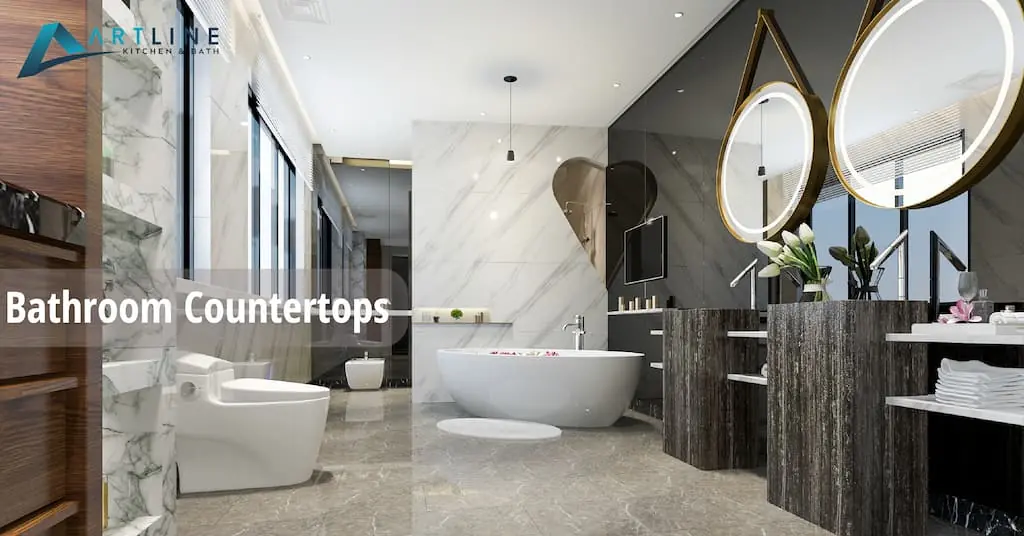
Bathroom countertop trends in 2026 are telling a clear story: homeowners want surfaces that feel permanent, not fashionable. After years of cold grays and stark whites, the entire countertop market has shifted toward warm neutrals, natural textures, and materials that age well rather than date quickly.
This post covers everything relevant to that shift: the top materials and what they actually cost; the color directions that are winning in master baths versus powder rooms; what’s quietly going out of style; and practical guidance for small bathrooms and tighter budgets. We’ve also included a side-by-side comparison of quartz, quartzite, granite, marble, porcelain, and Dekton so you can make a confident decision before calling anyone.
What’s Driving Bathroom Countertop Trends in 2026
The biggest shift this year isn’t a specific material. It’s a philosophy. According to the National Kitchen & Bath Association’s 2026 Bath Trends Report, 77% of design professionals say homeowners now want hotel and resort-inspired aesthetics in their own bathrooms. That means warm, calming surfaces, not showcase pieces that look great in photos but feel sterile to live with.
On the material side, quartz and quartzite are the two fastest-growing choices according to Kitchen & Bath Design News’ 2026 countertop survey of 300+ remodeling professionals. Natural stone accounts for nearly half of all countertop requests in high-end remodels. And porcelain slab, once a niche option, has quietly become one of the most practical choices for modern bathrooms.
Color-wise, cool grays are on the way out. Off-white leads 2026 palettes at 58% of design projects, followed by light brown and tan at 54%, and creamy whites at 40% (NKBA, 2026). If you installed a pure gray countertop five years ago, it still looks fine, but it no longer reads as current.

The Top 6 Bathroom Countertop Materials in 2026
Choosing the right bathroom countertop comes down to four things: how much maintenance you’re willing to do, what your bathroom style calls for, how long you plan to stay in the house, and your budget. Here’s a clear breakdown of each major material.
1. Quartz: Still the Safest Bet for Busy Bathrooms
Quartz remains the top choice for most homeowners, and the reasons haven’t changed: it’s non-porous, doesn’t need sealing, resists stains and moisture, and comes in hundreds of colors. What has changed is how it looks. The old quartz that tried too hard to mimic marble, and failed, has been replaced by products that actually fool the eye.
The 2026 quartz market is dominated by warm-veined slabs: creamy off-whites with gold or taupe veining, soft beiges, and subtle earth tones. Monochromatic cool grays are still available but declining in new installs. Data from industry tracking shows quartz now accounts for more than 50% of newly installed bathroom countertops.
Price range: $50–$200+ per square foot installed. The widespread reflects material grade, edge profiles, and cutouts. Mid-grade quartz for a standard vanity typically runs $75–$120 per sq ft all-in.
- Pros: No sealing, moisture-resistant, consistent color, long warranty from most brands
- Cons: Can look slightly artificial up close on low-grade products; not heat-proof (set down hot tools on a pad)
- Best for: Master baths, kids’ bathrooms, any high-use vanity

2. Quartzite: The Natural Stone That Actually Holds Up
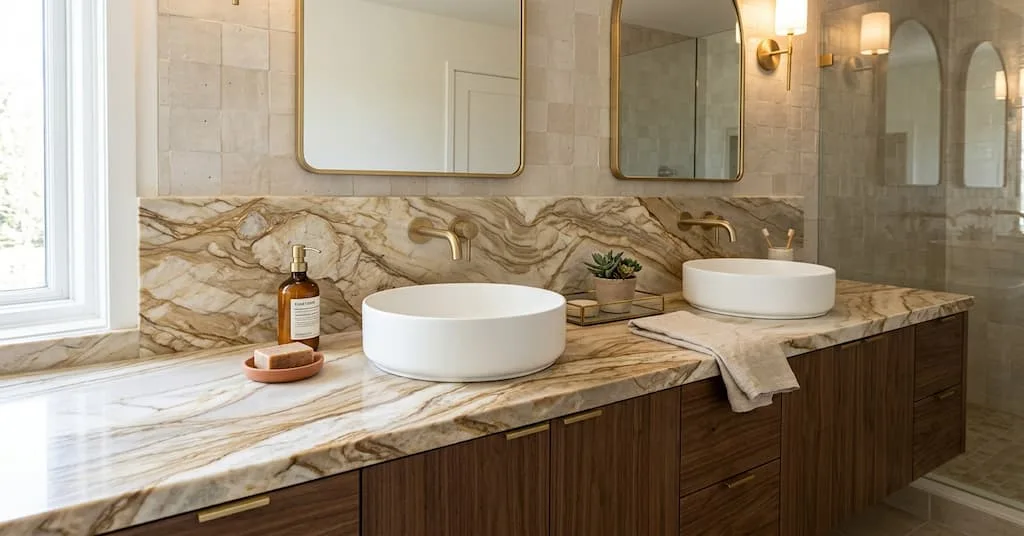
Quartzite is a natural stone, not to be confused with engineered quartz. It forms when sandstone is exposed to heat and pressure, resulting in a surface that’s harder than granite and often more visually dramatic. The veining in quartzite tends to be bolder and more irregular than marble, which is exactly why it’s trending in 2026: it looks expensive without trying.
Quartzite is heat-resistant and scratch-resistant. It does need periodic sealing; once a year is typical for bathroom environments, but it handles daily use well. Popular varieties in 2026 include warm-toned slabs with amber, caramel, and gold movement.
Price range: $60–$200+ per square foot installed, depending heavily on the slab rarity and source.
- Pros: Genuinely unique look, harder than granite, heat-resistant
- Cons: Requires sealing, more expensive than standard quartz, quality varies by source
Best for: Statement master bath vanities, spa-inspired bathrooms.
3. Granite: A Classic That’s Aging Unevenly
Granite is one of the most durable countertop materials available. It resists heat, scratches, and chips. Each slab is unique. The reason it’s fading in new installs isn’t due to quality; it’s because the most common granite patterns (heavy gray speckle, almost random movement) look visually dated in 2026 bathrooms that are trending toward cleaner, more directional aesthetics.
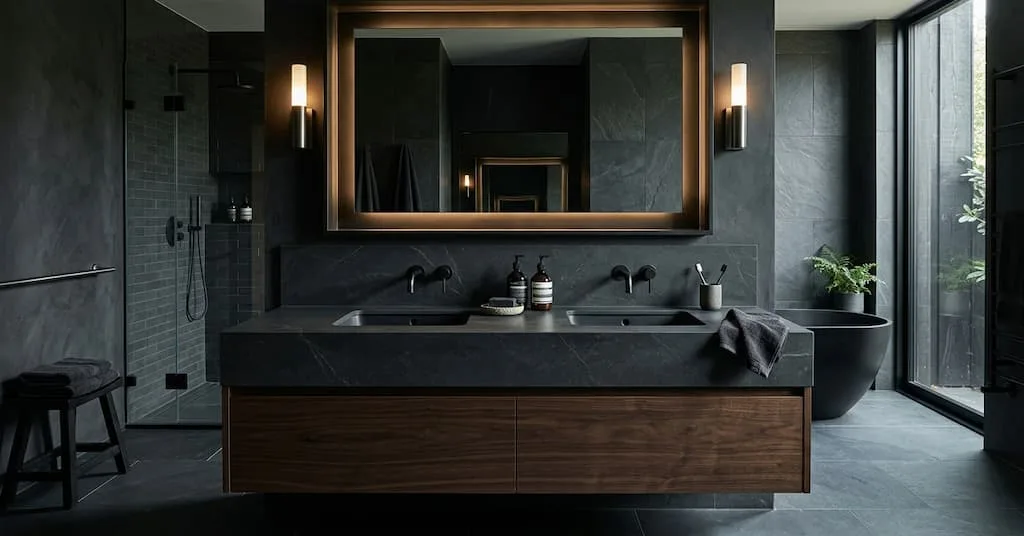
That said, granite in warm tones, deep walnut browns, sage greens, and rich blacks is still very much at home in transitional and traditional bathrooms. The key is slab selection. A well-chosen granite slab doesn’t read as dated at all.
Price range: $40–$200 per square foot installed. Granite is one of the more widely ranging materials in price because slabs vary so dramatically in rarity.
- Pros: Extremely durable, heat and scratch resistant, wide range of natural variation
- Cons: Requires sealing; the most common patterns feel dated in modern bathrooms
- Best for: Traditional, transitional, or rustic bathrooms, especially in warm and earthy tones.

4. Marble: High Reward, Real Maintenance
Marble bathroom countertops never actually went away. They just got honest about what they are: a high-maintenance surface that rewards people who actually take care of it. In 2026, marble is chosen deliberately, for primary baths in homes where aesthetics matter more than durability, for powder rooms that see light use, or for homeowners who simply love the look enough to manage it.
Carrara and Calacatta remain the most requested varieties. Newer preferences lean toward book-matched slabs with directional veining, a clean, architectural look rather than the random movement of older marble installs.
Price range: $75–$250+ per square foot installed. Book-matched or rare varieties can go higher.
- Pros: Unmatched natural beauty, unique per slab, adds resale appeal in luxury homes.
- Cons: Porous, stains easily, requires sealing every 1–3 years, and etches with acidic products.
- Best for: Powder rooms, low-traffic baths, homeowners who love the aging character.

5. Porcelain Slab: The Quiet 2026 Standout
Porcelain slab is one of the fastest-growing bathroom countertop materials in 2026, and most homeowners haven’t fully caught on yet. The material is essentially fired ceramic tile produced at a large-slab scale; it’s non-porous, doesn’t need sealing, and resists scratches, heat, UV, and moisture, and can credibly mimic marble, concrete, or stone without the maintenance required by any of them.
Large-format porcelain slabs (often 60″ x 120″ or larger) allow for seamless counter surfaces that look almost like a single piece of stone. The main limitation is brittleness during fabrication; it needs an experienced installer. But once installed, it’s one of the lowest-maintenance surfaces available.
Price range: $25–$75 per square foot for material; total installed cost runs $75–$150+ per sq ft depending on slab size and edge complexity.
- Pros: No sealing, highly durable, UV and moisture resistant, low maintenance
- Cons: Brittle during installation, fewer fabricators are experienced with it, and limited edge options
- Best for: Modern and minimalist bathrooms, anyone who wants a natural look without upkeep.

6. Dekton: Ultra-Compact and Built for Anything
Dekton is an ultra-compact surface made by Cosentino from a blend of raw materials used in glass, porcelain, and quartz. It’s fired at extreme heat and pressure, producing a surface that resists scratches, heat, staining, and UV light better than almost anything else. In 2026, Dekton’s new Amazonik line, with wood-grain textures and warm oak tones, shows how far the product has come from its all-industrial origins.
Dekton is a premium choice with a premium price. It requires skilled fabricators, and the material itself isn’t forgiving of mistakes. But for homeowners who want zero maintenance and maximum durability in a high-design bathroom, it’s hard to beat.
Price range: $70–$200+ per square foot installed. Expect to pay more for complex cuts and specialty finishes.
- Pros: Virtually maintenance-free, heat and UV-resistant, increasingly available in warm tones
- Cons: Expensive, requires specialist fabrication, less forgiving than some materials if damaged
- Best for: Design-forward homeowners who want a statement surface and zero upkeep.
Side-by-Side: Bathroom Countertop Material Comparison
Material | Durability | Maintenance | Cost / Sq Ft (Installed) | Best Bathroom Use |
Quartz | ★★★★☆ | Very Low (no sealing) | $50–$200+ | All bathroom types |
Quartzite | ★★★★★ | Low (seal yearly) | $60–$200+ | Master bath, luxury installs |
Granite | ★★★★★ | Low (seal yearly) | $40–$200 | Traditional, transitional baths |
Marble | ★★★☆☆ | High (seal + careful use) | $75–$250+ | Powder rooms, low-traffic baths |
Porcelain Slab | ★★★★☆ | Very Low (no sealing) | $75–$150+ | Modern, minimalist bathrooms |
Dekton | ★★★★★ | Very Low (no sealing) | $70–$200+ | High-end, design-forward baths |
2026 Bathroom Countertop Color and Finish Trends
Color trends in bathroom countertops this year are running in two directions at once, which may sound contradictory until you understand where each belongs.


Warm Neutrals Are the New Neutral
Cool grays and bright whites dominated bathroom design for the better part of a decade. In 2026, they’re being replaced by warmer counterparts. Off-white leads the shift in new bathroom design projects at 58%, followed by light browns and tans at 54%, with creamy whites at 40% (NKBA, 2026). These aren’t warm in a loud way, they’re warm in a “spa at 7 am” way.
Paired with natural wood vanities and matte black or brushed gold hardware, warm-neutral countertops produce bathrooms that feel deliberately designed rather than defaulted into. The veining in these slabs tends to run in taupe, gold, sand, and soft brown, which reads as luxurious without being aggressive.
Bold Color Belongs in Powder Rooms
The powder room has become the place where designers and homeowners take real risks, and the countertop is a major part of that. Black, deep navy, forest green, and dramatic veined stones are showing up in powder rooms specifically because the low daily-use volume means the higher-maintenance materials work fine, and the small square footage makes bold choices affordable.
A 24″ powder room vanity in a rich green quartzite or black marble makes a strong statement for a relatively small material cost. That’s the logic driving the trend.
Matte Finishes Over High-Gloss
The finish choice has steadily shifted toward matte and honed surfaces. High-gloss countertops show water spots, fingerprints, and toothpaste immediately, which is roughly the opposite of what you want in a bathroom. Matte and honed finishes absorb light rather than reflect it, hide daily marks naturally, and read as more sophisticated in 2026 bathrooms, where the aesthetic goal is calm and warm rather than polished and cold.
Leathered granite and honed marble are both benefiting from this shift. Even quartz manufacturers are prioritizing matte finishes over their older polished slabs.
Small Bathroom Countertop Trends and Ideas
Small bathroom countertop choices follow different rules than large master bath decisions. With limited counter space, the goal isn’t usually to make a material statement; it’s to make the room feel larger and more intentional.
Light and Warm Tones Expand Small Spaces
In smaller bathrooms, countertop color does real optical work. Light warm tones, creamy whites, soft tans, and warm beiges reflect light back into the room, visually pushing the walls outward. This is one area where the 2026 warm-neutral trend and small-bathroom logic align perfectly.
Avoid heavy veining or busy patterns in small bathrooms. The movement that looks dramatic and expensive on a 72″ double vanity just looks chaotic on a 30″ single sink. Clean, subtle surfaces work much better at scale.
Integrated Sinks and Waterfall Edges
Integrated sink countertops, where the basin is carved from the same material as the counter, are especially useful in small bathrooms. They eliminate the seam between the counter and sink,
making the entire vanity surface appear larger and easier to clean. This approach works well in quartz, solid surface, and porcelain.
Thin countertop profiles (¾” instead of 1¼”) also help in tight spaces; they look proportional where a thick slab would feel heavy. Floating vanities paired with thin-profile counters have become a standard approach for making compact bathrooms read more open.
Extending Stone Up the Wall
One of the stronger 2026 directions in small bathroom design is carrying the countertop material up the backsplash wall, sometimes all the way to the mirror. This creates a continuous stone surface that makes the vanity area feel like a single designed element rather than a collection of pieces, and it effectively makes the countertop material a larger part of the visual field without increasing the actual counter footprint.
Budget-Friendly Bathroom Countertop Options
The 2026 market offers genuinely attractive options at lower price points. The key is knowing what to compromise on and what not to.
What You Can Get Under $60/Sq Ft
Laminate countertops have improved dramatically. The new generation of high-definition laminate, with textured surfaces and printed stone looks that hold up at arm’s length, starts around $20/sq ft for material. They’re water-resistant (not waterproof), easy to DIY-install, and come in essentially any color or pattern. They won’t last forever, but for a rental property bathroom or a guest bath that sees light use, they’re a reasonable choice.
Tile countertops remain a popular DIY option because of the low material cost and the design flexibility. Large-format porcelain tiles in a stone look give you a much more finished result than the small-tile vanity tops of past decades. The grout line is the main drawback for countertops, it needs regular cleaning and re-sealing.
Mid-Budget: $60–$100/Sq Ft
This is where solid surface (Corian and similar), cultured marble, and entry-level granite and quartz all compete. Cultured marble, resin, and marble dust are often used for integrated-sink bathroom tops at this price range and give a seamless look at a reasonable cost. It scratches more easily than stone but can be polished back.
Entry-level granite and quartz from domestic sources now regularly come in at $60–$90/sq ft installed for standard bathroom applications. The visual quality is typically very good. The price difference stems from the limited color/pattern selection compared to premium slabs.
Where to Invest vs. Where to Save
- Invest in the material for master baths; you’ll see it every day, and it affects resale value
- Save in secondary bathrooms and guest baths; laminate or entry-level porcelain reads fine
- Never compromise on fabrication quality; a beautiful $80/sq ft slab installed badly looks worse than a $40/sq ft slab done right
- Edge profiles add cost quickly; a simple eased edge versus a full ogee can add $10–$20/linear foot
What’s Going Out: Trends to Avoid in 2026
Knowing what not to choose is sometimes more useful than knowing what’s trending. Here’s what designers are calling out as dated in 2026:
- Waterfall edges everywhere, 36% of designers flagged this as overdone (Apartment Therapy, 2026). The style had a huge moment; now it reads as a flip renovation cliché.
- Cool gray marble, especially heavy gray veining with aggressive movement. Light, timeless Carrara still works. Dark frenetic gray marble looks very 2019–2022.
- High-polish everything, the all-mirror surface that shows every water drop. Matte and honed have largely won the finish debate.
- Speckled granite, the heavily spotted patterns that dominated early 2000s bathrooms. Some granite is still excellent. That specific look isn’t.
- Pure bright white, paired with chrome, the combination looks dated without warm elements to balance it. Off-white with brass or bronze hardware has largely replaced it.
Bathroom Countertop Design Ideas by Room Type
Master Bath: Spa Energy, Warm Stone
Master bathroom countertops in 2026 are designed to feel like the beginning and end of a good day. The dominant approach is warm quartzite or quartz in an off-white or creamy tone, paired with a wood-finish vanity and matte black or brushed brass hardware. Honed finishes over polished. Double sinks on 60″–72″ vanities where the space allows.
Undermount sinks remain the standard for master baths; they keep the counter clean and easy to wipe down. Book-matched stone slabs are showing up in high-end master baths as a statement element, particularly in the shower surround carried from the counter material.
Powder Room: Where Bold Works
The powder room is the one space in most homes where a bold countertop choice makes complete sense financially. You’re covering maybe 6–10 square feet of countertop on a vanity that might be 24″ wide. A material that would cost $3,000 for a master bath runs $400–$600 here. That’s the logic behind the dark marbles, deep green quartzites, and dramatic black granite showing up in powder rooms across 2026 design projects.
Vessel sinks in powder rooms also open the counter up to be part of the display, a beautiful slab that’s mostly visible rather than covered by daily toiletries.
Kids’ and Guest Bathrooms: Durable First
Kids’ bathrooms and guest baths reward a different set of priorities. Durability and easy cleaning matter more than design drama. Quartz is the go-to choice here; it doesn’t stain, doesn’t need sealing, and handles everything a bathroom can throw at it. Solid colors or very subtle patterns are easier to keep looking clean than statement slabs in high-traffic bathrooms.